
Best Garage Floor Coating Options: Epoxy Flake vs Metallic vs Solid Color
Choosing the right garage floor coating comes down to three things: how you use the space, what your concrete looks like, and what you want the finished floor to look like five years from now. The most popular options — epoxy flake, metallic epoxy, and solid color epoxy — each deliver a durable, professional result, but they’re not interchangeable. This guide breaks down exactly how they differ so you can pick the one that actually fits your garage.
At Gulf Coast Paint Manufacturing, we’ve been formulating industrial-grade protective coatings along the Gulf Coast for decades. Garage floor systems are one of the most common questions we field from homeowners in Alabama, Florida, and Mississippi— and the answer is almost always “it depends.” Here’s how to figure out which system is right for yours.
Epoxy Flake Flooring: The Best All-Around Garage Floor Coating for Most Homeowners
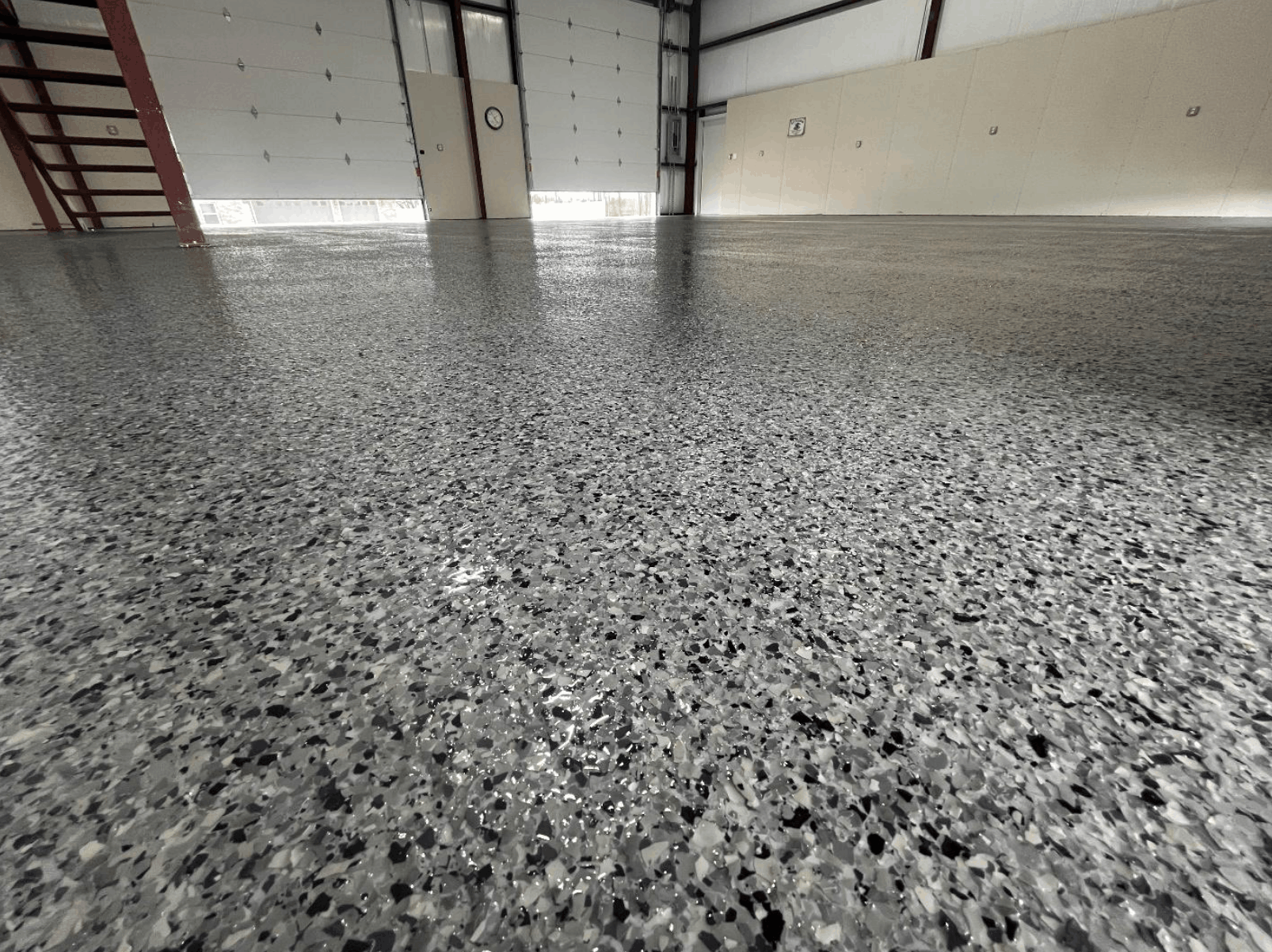
Walk into a car dealership, fire station, or commercial garage and you’ll almost certainly see an epoxy flake floor. That’s not a coincidence. The chip broadcast system has become the go-to for working floors because it handles real use — oil drips, dropped tools, heavy tires, hose-down cleaning — without looking like it does. It’s the practical pick, and for most residential garages, it’s the right one.
How an Epoxy Flake System Is Applied
A high-solids or 100% solids epoxy basecoat goes down on the prepared concrete first. While it’s still wet, vinyl color flakes (also called chips) are broadcast across the surface — either partially for a speckled look, or wall-to-wall for full coverage and maximum texture. After cure, excess chips are scraped off and one or two coats of a clear polyaspartic or polyurethane topcoat seal everything in. That topcoat is what gives you UV stability, chemical resistance, and long-term gloss.
What Epoxy Flake Floors Look Like
The finished look depends entirely on the flake blend. Earth tones and granite-style mixes give you something that reads like stone or terrazzo from across the garage. Brighter blends — blues, reds, custom shop colors — make a stronger statement. Full broadcast coverage creates a heavily textured surface; partial broadcast keeps more of the base color visible for a lighter, more decorative look. Either way, the floor doesn’t look “coated” — it just looks finished.
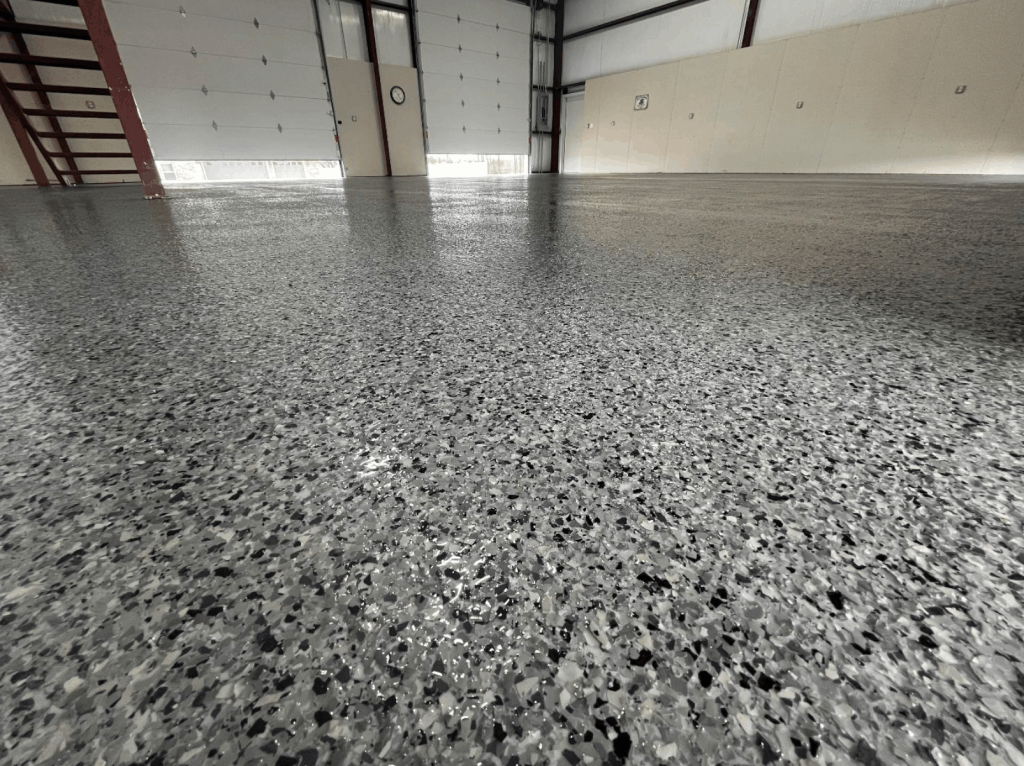
Gulf Coast Paint Flake Floor System: PC-1850 100% Solids Epoxy basecoat + PC-1900 Polyaspartic topcoat
Where Epoxy Flake Outperforms the Alternatives
The chip texture does a few things no other system can match. First, it hides what’s already on the concrete — old stains, minor cracks, patched spots, the general character of a slab that’s been a garage floor for twenty years — better than any other finish. Second, the texture adds natural slip resistance without a separate additive, which matters when the floor gets wet. Third, it’s forgiving during application. Lap marks and minor inconsistencies that would show up in a solid color disappear under flake coverage.
It also touches up cleanly. If you catch a chip or gouge years down the road, spot repairs blend into the flake pattern in a way that’s nearly invisible. With metallic or solid color, a repair almost always shows.
The One Trade-Off Worth Knowing
That chip texture collects dust and fine debris in a way a smooth floor doesn’t. It’s easy to blow out or mop, but if you’re running a precision shop where floor cleanliness is critical, the smoother surface of a solid color or metallic system might suit you better. Also, flake won’t turn heads the way metallic does — it’s built to perform, not to be the centerpiece of the room.
Metallic Epoxy Garage Floors: When the Floor Is Part of the Design
Metallic epoxy is in a different category entirely. Done right, it doesn’t look like a coated floor — it looks like polished stone, molten metal, or a deep ocean surface caught mid-movement. The three-dimensional depth surprises people when they see it in person for the first time. If you’re building out a showroom garage, a man cave, or a home gym space where the floor is supposed to make an impression, this is your system.
How Metallic Epoxy Is Applied
A 100% solids epoxy mixed with finely milled metallic pigment powders gets poured across the prepared slab and spread with a squeegee. From there, the installer manipulates the wet epoxy — using rollers, compressed air, additional solvents — to push the metallic pigment into swirling, flowing patterns before it cures. No two metallic floors look identical, which is part of the appeal. A clear urethane topcoat goes on over the cured layer for protection and gloss.
What Metallic Epoxy Floors Look Like
Silver and black combinations give you that high-contrast industrial look. Copper and bronze tones read warmer and more traditional. Ocean blues and greens create something that genuinely looks like water under glass. Pearl white over a dark primer produces a luminous, almost backlit effect. The gloss level is typically very high, which amplifies the depth and makes the floor photograph well. That’s not just vanity — it also makes the space feel larger and brighter.
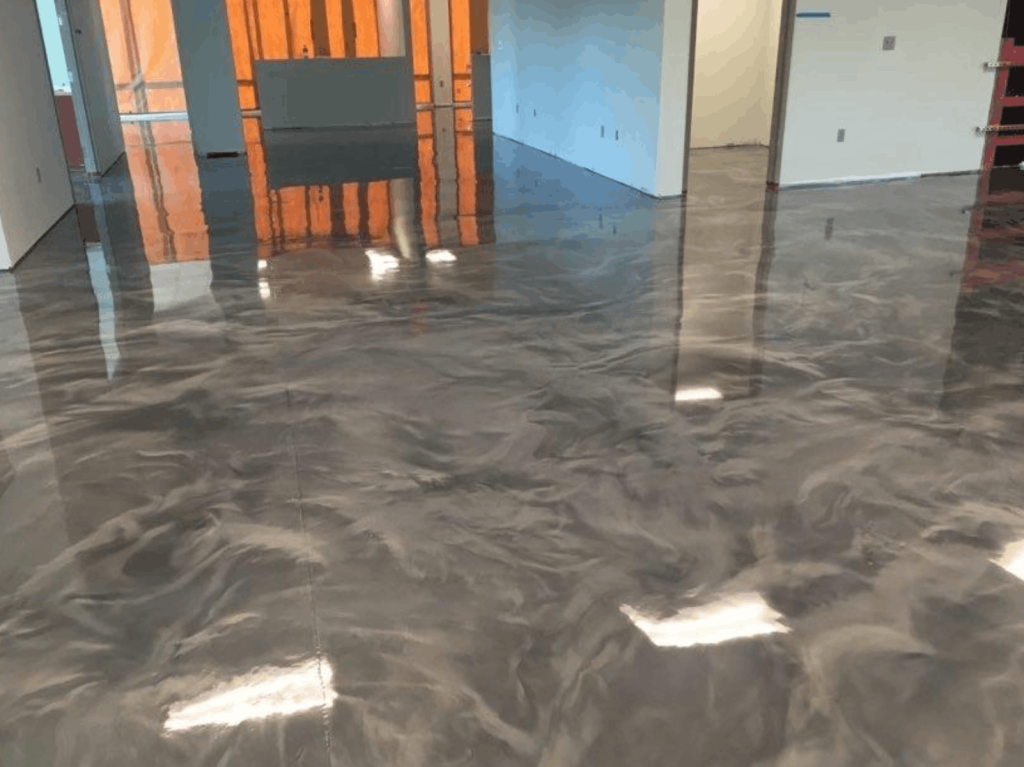
Gulf Coast Paint Metallic Floor System: PC-1703 Black Epoxy Primer + PC-1820 100% Solids Epoxy with metallic pigment + CT-332 Clear Polyurethane Topcoat
Where Metallic Epoxy Earns Its Premium
The smooth, high-gloss surface is genuinely easier to keep clean than a textured chip floor. Sweeping and mopping are straightforward, and nothing settles into the surface. Chemical resistance is solid with a quality topcoat. And the visual impact is simply in a different league — if aesthetics matter, nothing in this category competes.
What to Know Before You Commit to Metallic
Metallic epoxy is the least forgiving system on this list. Because the surface is smooth and high-gloss, concrete imperfections — cracks, divots, spalling, old stain spots — show through more clearly, not less. Thorough surface preparation isn’t optional here; it’s what separates a floor that looks like art from one that looks like an expensive mistake.
Application is also more skill-dependent than the other two systems. The pigment manipulation happens in a short working window, and getting a consistent, intentional pattern takes practice. DIY results vary widely. If you’re hiring a contractor, ask to see photos of completed jobs — recent ones, not renderings.
One more thing: the smooth finish means less inherent slip resistance. An anti-slip additive in the topcoat — aluminum oxide is the standard choice — is worth adding, particularly if the garage doubles as a workspace rather than a display area.
Solid Color Epoxy Garage Floors: The Clean, Underrated Option
Solid color epoxy/urethane doesn’t get the attention that flake or metallic does, but it’s worth taking seriously. A properly built solid color system — right products, right film build, right surface prep — produces a floor that’s clean, durable, and timeless in a way the flashier options sometimes aren’t. It also happens to be the most cost-effective of the three.
How a Solid Color Epoxy System Is Built
A proper solid color system is two to three coats: a primer or epoxy basecoat, a pigmented epoxy body coat, and a pigmented aliphatic polyurethane topcoat for UV stability and long-term color retention. Some systems combine the color and protection into a single finish coat. Either way, film thickness matters — the single-coat big box kits are not a coating system regardless of how they’re marketed. You need adequate mil build to get durability out of a solid color floor.
What Solid Color Garage Floors Look Like
Exactly what it sounds like — a uniform, single-color surface with a gloss or satin finish. Light and medium grays are perennial favorites because they hide tire marks, read clean, and work with almost any garage aesthetic. Dark charcoal gives you a more dramatic look; warm tans read more residential. Bold colors are an option too if that fits the space. The look ages well and doesn’t feel dated when design trends shift.
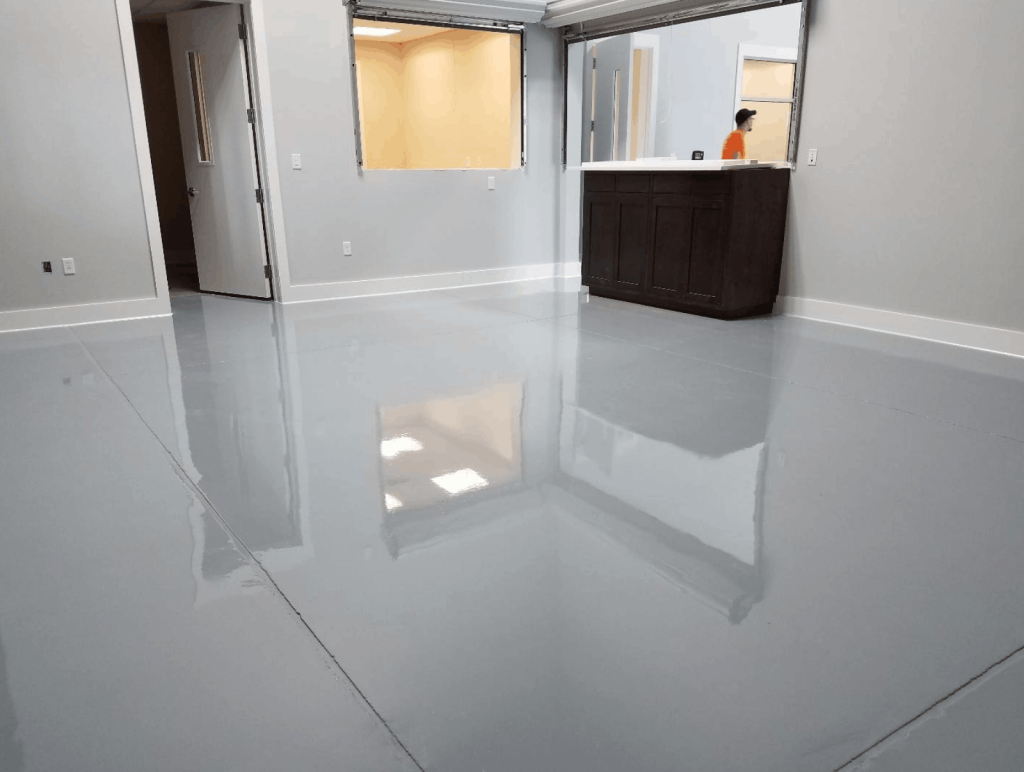
Gulf Coast Paint Solid Color System: PC-1703 Gray 100% Solids Epoxy Primer + CT-352 Light Gray Polyurethane Topcoat
Where Solid Color Systems Make the Most Sense
Solid color is the best option for shops and working garages where you need to see the floor clearly — wear spots, thin areas, and damage are much more visible against a uniform color than under a chip pattern. It’s also the easiest to match if you’re coating a floor in sections or phases. And because it’s the most cost-effective of the three systems, it’s a reasonable starting point if you’re not sure how long you’ll be in a space or what your next renovation looks like.
The Trade-Offs for Solid Color
It hides concrete imperfections less effectively than flake. Cracks, patches, and surface variations telegraph through a solid color in ways they wouldn’t under full-broadcast chips, so your surface prep work has to address any cosmetic issues upfront. Application technique also matters more — lap marks and roller lines that would disappear under flake are visible in a uniform color. The products and the applicator both have to be on their game.
How to Choose the Right Garage Floor Coating System for Your Home
Four questions cut through most of the uncertainty:
Is This a Working Garage or a Showcase Space?
Regular vehicle traffic, tools on the floor, oil drips, hose-down cleaning — that’s a flake floor. It’s built for exactly that, and it performs there better than the other two. Display space, home gym, finished garage room you actually spend time in — metallic is worth the investment.
What’s the Condition of Your Concrete?
Older slabs with staining, patches, and surface character will look best under a full-broadcast flake system. Clean, well-prepared concrete gives you real flexibility across all three. Metallic on a poorly prepped slab is how expensive projects turn into expensive disappointments.
What’s Your Budget?
Solid color is typically the most cost-effective because it uses fewer material layers. Flake falls in the middle, while metallic tends to be the highest cost due to additional material and labor.
Questions About Your Garage Floor? Talk to the Gulf Coast Team.
All three systems — epoxy flake, metallic, and solid color — can deliver a garage floor that holds up for a decade or more when they’re specified and applied correctly. The choice comes down to how you use the space, what shape your concrete is in, and what you want to look at every time you pull into the garage.
If you’re not sure which system fits your situation — or if you want a product recommendation based on your specific concrete condition, climate, and how the garage is used — we’re glad to help work through it. Gulf Coast Paint Manufacturing has been supplying high-performance coatings across the country for many years. We know these environments, and we know what holds up in them. If you’re along the Alabama Gulf Coast, Mississippi Gulf Coast, or Florida Panhandle and want to make sure you’re choosing the right garage floor coating system for your climate and concrete condition, give our team a call. We can also recommend an installer to do the work.
Call us at 251-964-7911, email info@gulfcoastpaint.com, or browse all of our garage floor coating products at www.gulfcoastpaint.com.

You must be logged in to post a comment.